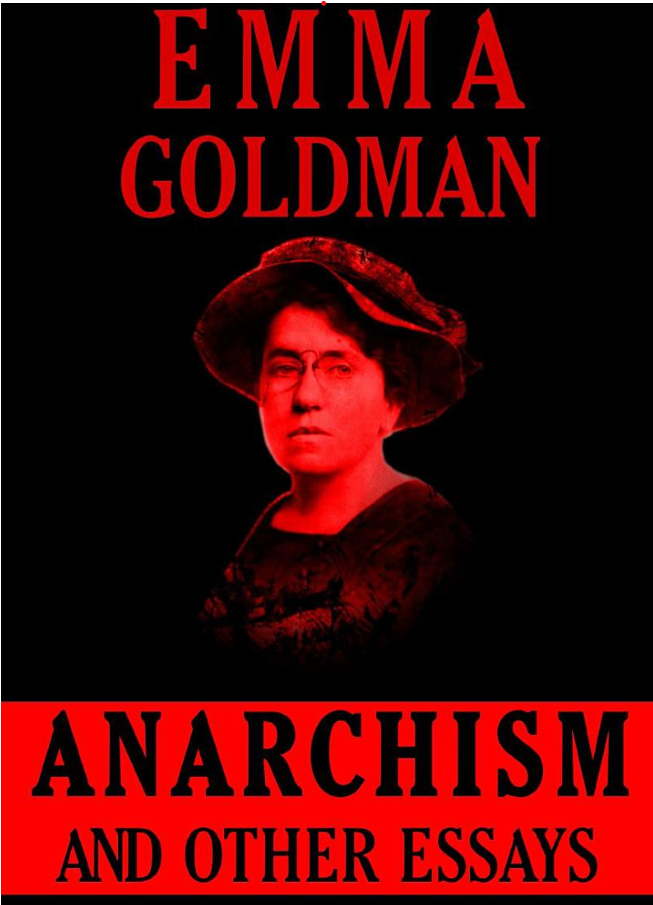
This collection of essays by Emma Goldman is an interesting mix of evergreen and “of their time” discussions. I picked it up to better understand the ideas of Anarchism; I had only ever had a negative and superficial opinion of the anarchists because it seems self-evident to me that people in an anarchic environment would quickly devolve into society “red in tooth and claw”. It isn’t necessary that all people take license with the freedom provided by anarchy; even a small percentage of a large population would seem able to cause sufficient suffering to discredit the concept. Recent events here in America – the second election of Trump and supplication of the supposedly powerful elite – have led me to reconsider the stability of civil society and reconsider the ideas of the Anarchists, Luddites, and other alternative societies.
Ms. Goldman’s first essay, Anarchism: What It Really Stands For seemed to the the right entry point to understand the anarchists from their own perspective.
“Anarchism urges man to think, to investigate, to analyze every proposition; but that the brain capacity of the average reader be not taxed too much, I also shall begin with a definition, and then elaborate on the latter.
ANARCHISM: – The philosophy of a new social order based on liberty unrestricted by man-made law; the theory that all forms of government rest on violence, and are therefore wrong and harmful, as well as unnecessary.
The new social order rests, of course, on the materialistic basis of life; but while all Anarchists agree that the main evil today is an economic one, they maintain that the solution of that evil can be brought about only through the consideration of EVERY PHASE of life, – individual as well, as well as the collective; the internal, as well as the external phases.”1
The concept of Anarchism as a wholistic philosophy of whole people, not merely unfettered but also self-actualized and complete, is very appealing. Calling out the collective simultaneously with the individual incorporates the pro-social aspects of humanity at the same time as our individuality; we cannot be complete without relationships to others, and the philosophy demands that we allow them their own liberty and wholeness as well. This is further developed in what are probably some of the most problematic passages when read today, those decrying the suffragette movement:
“We boast of the age of advancement, of science, and progress. It is not strange, then, that we still believe in fetish worship?…. Our modern fetish is universal suffrage.”2
Superficially this essay reads as opposed to the equality of women; but the point is really to oppose the those who struggle for the form (“fetish”) of liberty and equality without really getting to the wholeness of it. A woman who can vote, but is not paid for her labor or follows the crowd to elect governments that keep her and others in bondage is not truly free; or at least, is not on right side of history. Voting to remain enslaved because you have been taught it is necessary is not intrinsically good. In her concern that the forms of liberty will just lead to women having more responsibilities and less leisure or ability to care for themselves she sounds modern indeed. She is deeply concerned with the hypocrisy of individuals in practice:
“Every movement that aims the destruction of existing institutions and the replacement thereof with something more advanced, more perfect, has followers who in theory stand for the the most radical ideas, but who, nevertheless, in their ever-day practice, are like the average Phillistine, feigning responsibility and clamoring for the good opinion of their opponents. There are, for example, Socialists, and even Anarchists, who stand for the idea that property is robbery, yet who will grow indignant if anyone owe them the value of a half-dozen pins.”3
and saves her most effusive praise for those whose martyrdom demonstrates their greater empathy and commitment, people like Angiolillo and Gaetano Bresci:
“[Angiolillo] read of the great wave of human sympathy with the helpless victims at Montjuich. On Trafalgar Square he saw with his own eyes the results of those atrocities, when the few Spaniards, who escaped Castillo’s clutches, came to seek asylum in England. There, at the great meeting, these men opened their shirts and showed the the horrible scars of burned flesh. Angiolillo saw, and the effect surpassed a thousand theories; the impetus was beyond words, beyond arguments, beyond himself even.
Senor Canovas, about to leave his house, stepped on the veranda. Suddenly Angiolillo confronted him. A shot rang out, and Canovas was a corpse.
[…] Calmly Angiolillo faced death […] the man whose soul was as a child’s.
He was garroted. His body lay, sun-kissed, till the day hid in twilight. And the people came, and pointing the finger of terror and fear, they said: ‘There – the criminal – the cruel murderer.”
How stupid, who cruel is ignorance! It misunderstands always, condemns always.”4
It is clear where Ms. Goldman would sit on the debate around Luigi Mangione.
I find it unclear to see how the practical political project of Anarchism could work, give the low opinion the author shows here and elsewhere for the average person in the teeming mass of humanity. The totalitarian has a solution to this, as does the capitalist and the democrat, either through domination and control or by lowering the aim from the ideal to the practical. Perhaps the idea is that in a world so far from the ideal it’s necessary to propose the impossible just to break the inertia.
It’s interesting to read the essays with the understanding that it was originally printed in 1910, in the twilight of a 19th century world still led by the crowned princes of Europe while Wyatt Earp was summering in Los Angeles trying to get a movie made about his exploits at the OK Corral. Only a few years later that world would be destroyed in the trenches of the western front. Against that backdrop the opposition to militarism in Patriotism: A Menace to Liberty is both prophetic – with the terrible cost of those wars demonstrating just how dangerous mindless tribal patriotism is – and also naive. It’s hard to see how unilateral demilitarization and liberty could survive in a world with neighbors like the European nation-states. Her assertion of the impossibility of war,
“The usual contention is that we need a standing army to protect the country from foreign invasion. Every intelligent man and woman knows, however that this is a myth maintained to frighten and coerce the foolish. The governments of the world, knowing each other’s interests, do not invade each other. They have learned that they can gain much more by international arbitration of disputes than by war and conquest.”5
rings hollow since we know the story of the next decade. A stable anarchic environment (oxymoronic is that sounds) would seem impossible unless universal; and even then it would appear to be an unstable equilibria. Even this misunderstanding, however, echoes the current moment and the failed neo-conservative dreams of the end of history popular at the turn of the century. Both are cuspal moments. These essays are worth reading if only to see how the cycles of history rhyme.
A PDF copy of the collected essays is available at https://libricom.org, though I read the Affordable Classics version printed in 2021; I presume but have not verified that they are the same.
- from Anarchism: What It Really Stands for, collected in “Anarchism and Other Essays” by Emma Goldman, published 2021 by Affordable Classics, page 26 ↩︎
- from Women Suffrage, ibid, page 100 ↩︎
- from The Tragedy of Woman’s Emancipation, ibid, page 111 ↩︎
- from The Psychology of Political Violence, ibid, page 51 ↩︎
- from Patriotism: A Menace to Liberty, ibid, page 67 ↩︎
Leave a Reply